On Electronic Literature
The Rise of Electronic Literacy
As technology has progressed, so to has our method of
communication. Just as there were changes as the world moved from a mode of
orality to literacy, there have been an equal number since the transition from
literacy to electracy. In particular, the multimedia format commonly used in
social media platforms has given rise to evolutions in literature. This post will examine three new styles of writing – e-poetry, TikTok skits, and video
essays – to determine exactly what ways technology has shaped its form and what
this might mean for the future of literature.
According to Leonardo Flores, a scholar in electronic
poetry and the founder of the catalogue site I ❤️ E-Poetry,
e-poetry is “poetry that arises from an engagement with the possibilities
offered by digital media” (Flores). An important aspect that distinguishes this
form is the method of integration by the technology used to process it; rather
than being “marked by digitality, electronic literature is actively formed by it”
(Hayes). For example, consider the following poem “Puddle”
by Neil Hennessey.
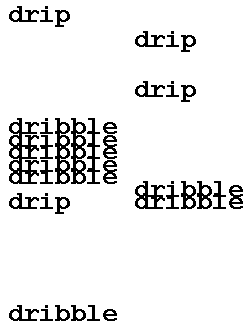

This poem is considered to be a concrete kinetic piece. Kinetic poetry
is a subsection of e-poetry; it is marked by using the computer’s ability to
display animation. In this case, the technology available advises the form of
the piece itself. Being able to utilize animation, or in this case the gif
format, allows for the denotation of the word to be visually understood in a
way that would be lost if it were simply printed on a piece of paper. In simply
reading the words “drip”, “dribble”, and “ripple”, this piece’s poetic meaning
would be lost.

of videos that are uploaded range from reactions to pranks to other short bits of entertainment, the constraints of the format have led to interesting new forms of literature. For example, take the TikToker AmericanBaron, who has risen in popularity due to his perfection of the subformat known as the “perfect loop.”
Consider this video (alternate link) that explores the meta concept of the loop format. An important aspect
of any perfect loop is that the ending and beginning match up seamlessly so the
content in question can go on forever. This format lends itself heavily to the
nonsensical; one can watch this video and feel a sense of insanity trying to
understand where the video starts and ends, as it never ends and therefore
never technically starts.
This subtype is not
limited to discussing the meta, however. The format also lends itself to the
topics of existentialism and philosophy, both which Baron Ryan frequently
touches on. Consider the working for happiness loop (alternate link), in which Ryan discusses where happiness comes from with an alien
figure. In this video, Ryan explores the paradox of humans working unhappy jobs
to not be unhappy.
While the video lends itself to the
never-ending loop of existentialism, it also highlights another feature of the
TikTok format: the use of filters to distort one’s appearance. The use of the
alien filter provides a backdrop in the video in which humans must explain
their behavior to nonhuman entities; in doing so, the over explanation
highlights the absurdity of humanity itself. The filter technology likely
provided inspiration in the creation of the video; without the ease of
distorting one’s appearance, it is quite possible the concept might not have
come to fruition.
The use of visual aids in driving home the
point of one’s electronic writing is not limited to short video skits; another
format that is enhanced through the use of visual media is known as the video
essay. Unlike traditional academic essays which can cover a variety of
subjects, the most popularized video essays tend to revolve around technology
and multimedia itself. Take for instance, the YouTuber Sarah Z, who has written videos essays surrounding a
multitude of internet topics, including “The Late Capitalism of Fast Food
Twitter”, “Online Boundaries and Emotional Labor”, and “Tumblr's FAKEST Story: The Tale of Oppa Homeless Style.”


During her exploration of the topic, Sarah Z
spent an inordinate amount of time crosschecking usernames and origin sites.
Her investigation led to an interesting outcome. Not only was the post in
question fake, but it had never originated on Tumblr; it was actually a post
doctored to appear that it came from Tumblr and instead was originally uploaded
to r/ThatHappened, a subreddit dedicated to calling out egregiously fake posts
and mocking the initial user.
What is more, it turns out that several of the
most popular fake Tumblr posts were doctored by this reddit user, MechaMew2, in
order to gain karma and mock the “cringe-worthy antics” of the communities his
doctored posts centered around. In essence, Sarah Z’s video essay led to the
exposure of a hate-content farmer.
Overall, it was the use of the visual media
that allowed Sarah to make her argument in a clear, concise manner. For each
twist and turn in the essay, Sarah was able to provide an accompanying visual
aid so that the audience could easily follow along. Left simply to paper, one
might become confused and overwhelmed at the sheer number of links needed to
follow to keep up with her argument as it develops. The conversational tone of
video essays, something often not acceptable in academic essays, also helps in the
ease of consumption.
Just as the constraints of the video essay lead
to visually-aided arguments about internet culture, so to the constraints of
TikTok skits lead to existential perfect loop videos and the constraints of
kinetic e-poetry lead to animated denotations. While each style of writing is
unique unto itself, they all three share things in common: people desire easily
consumed, visually aided forms of content. While it is still too soon to gather
the full breadth of how the internet and technology will impact the future of
literature, essays like this one, that explore the cause and outcome of new
styles of writing afforded to us by innovation, allow for a peak into the
future of where electracy might take us.
Comments
Post a Comment